I had heard quite a bit about Larry Correia and this series prior to reading this first novel, so my expectations were high and this novel delivered. What really strikes me about this novel is the writing style. It is unapologetic in its enthusiasm for guns, fighting supernatural creatures, and testosterone. Although men are the target audience, I think this also can appeal to a wider audience because the story telling and characterization are strong enough to carry it through to all demographics.
The story starts with Owen Pitt throwing his werewolf boss out of a window to his death (something I’m sure many people fantasize about). That leads to him joining Monster Hunter International, a company that specializes in killing things that are otherworldly. The main plotline is a Portuguese conquistador from the 16th century becoming a cursed creature with the sole intent of ripping open the fabric of the universe in order to rule this world, and bring on the apocalypse in the process. Owen is getting visions in his dream linking him to this Cursed One. To complicate matters, the Cursed One has seven master vampires doing his bidding, which apparently is unheard of in this story world.
Although I liked this novel, I thought it was a bit longer than it needed to be. I think some trimming would have benefited the novel. I also thought the fighting scenes were not as good as the non-fighting scenes, although the overall quality of the storytelling in general is quite high. Overall, this was an enjoyable novel that I would recommend.
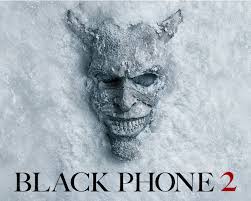
When I first heard they were making a sequel to Black Phone—which I thought was a phenomenal horror movie—I wasn’t terribly excited about the prospect. I thought the entire story was told and there was no need to make another movie, other than for the typical money grab that Hollywood is so fond of. Despite that, I tried to keep an open mind when watching Black Phone 2.
The movie exceeded my expectations. Now, I still believe that this movie did not need to be made, but with that caveat, they did some good things with this movie. Right off the top, I think the main actors who played brother and sister, Finn and Gwen, are both talented actors who hit the right notes in this movie. They have good chemistry together and carried the movie well. I also thought there was good horror elements throughout, with an exciting ending. Having said that, there were some definite gaps in the logic. Probably my biggest issue was that they wanted to have this cool setting—a youth camp in Colorado in the dead of winter—but the writers couldn’t be bothered to give a plausible explanation of why they were at this camp at that time.
Overall, I did enjoy this movie, and although I would say it’s unnecessary to drop everything you’re doing and watch this movie, it is worthwhile to see it.
Weapons was an interesting story. The premise behind it (a witch takes control of people and can use them as weapons) is interesting, but what I really enjoyed about the movie was the way the story unfolded and how the story was told. The story has a good mystery component and part of why it is mysterious is that only bits of are revealed as each main character’s story is told. Each primary character has their own chapter in the movie where the movie is shown from their point of view. More of the movie is revealed progressively from these different character perspectives.
In the movie, a classroom full of children disappear one day when they all leave their houses at the same exact time and all run in the same direction. It does get bit wonky here, because the police and FBI are too stupid to properly investigate this case whereas a parent seems to have no problem breaking down the investigation. Mostly this story is logical and doesn’t make me have to suspend disbelief too much. The conclusion is a bit brutal but also well done. With seemingly every major horror release being a sequel, it was nice get a novel movie that can stand on its own without being part of an existing series.
In the third Alex Verus novel, apprentices are going missing, and naturally Alex finds himself in the middle of the situation. He has a greater vested interest in the situation since he now formally has an apprentice in Luna. As usual, there are multiple layers to this story with various potential adversaries and good twists and turns along the way.
The writing in this novel is quite good. Benedict Jacka is a skilled writer who can weave together interesting stories that are fun to read. I would say this novel is not quite as compelling as the first two books in the series. The story itself that was a fun read but a notch below the other two novels I have read from Jacka. I do enjoy how Alex Verus uses his divination skills to his advantage to solve most of his problems. As far as magical abilities go, this is a pretty cool to one to have.
The ending was a little disappointing. It just didn’t seem to have the type of finality where antagonist is killed and protagonist can move on. It was more of a negotiated ending. So, it wasn’t the most satisfying of endings, but overall this was a good read that won’t disappoint readers of the series.
The Institute is a bit of a mixed bag. There was a lot that I liked in this novel, but there were some really serious negatives as well. In this stories, children who display telekinetic or telepathic abilities are kidnapped from their homes and transported to a remote location in Maine where they are first tested and given various stimulus and are later transferred to the “Back Half” portion of the facility, where the children collectively are being used to assassinate people.
I’ll start with the parts of this novel that I liked. The writing, of course, is very good. That’s always a given with Stephen King, as he is a master of his craft and I would expect no less of him. The characterization is also very good. Stephen King is not only a master at writing but his children characters are always so well developed and this novel is no exception. The characters are really strong.
Now to the bad. The logic behind this story is abysmal. Spoilers ahead so beware. So, I’m supposed to believe that an organization that is mostly staffed by ex-military and former law enforcement officials are willing to kill parents and kidnap children where they are used up and eventually die as well. And that they are willing to do this on some vague notion with absolutely no supporting evidence that what they are doing is saving the world. I’m also supposed to believe that this has been going on for roughly six decades and hundreds if not thousands of these children have been kidnapped and their parents murdered, and in all of those cases there was never a single competent detective or police force that couldn’t connect the dots that this was happening repeatedly all over the country and then trace it back to this institute. There are other preposterous leaps in logic and every time the author tried to explain this ridiculousness, he made it worse because it made no sense. Other than that, the novel drags a bit in the middle.
In the end, this was an entertaining novel with some significant holes. If I could give it three and a half stars, that’s how I would rate it. It’s worth reading.
I’ve had the pleasure of reading a number of Jeff Strand novels, and if you are anticipating the generally light-hearted humorous novels that you get out of Strand, Pressure is most certainly not that. This novel is dark. Really dark. Every time I would get to a scene thinking there would be some sort of not so bad outcome for the character, it turned out far worse for them than I would have anticipated. This book is a pretty rough read.
Having said all of that, I enjoyed reading it. Even when I would have liked it to be a bit more cheery and humorous, the novel delivered, just not how I thought it would. The story starts off with Alex Fletcher being sent to a boarding school where he meets Darren Rust, who is a budding psychopath. After an incident involving mutilating a fellow classmate’s dog, they part ways only to be reunited in college. Alex makes the worst possible decision of befriending Darren, which turns out to haunt him both in college and later in life as Darren is hell bent into turning Alex into a fellow psychopathic killer.
The writing is strong as is the characterization. Even after experiencing the worst possible outcomes in his life from his interaction with Darren, he still never succumbs into being what Darren is and shows strength and resiliency, even while still gaining the revenge that he seeks. So, although I would not put this at the top of the Jeff Strand heap of books, it was an enjoyable read that I would recommend.