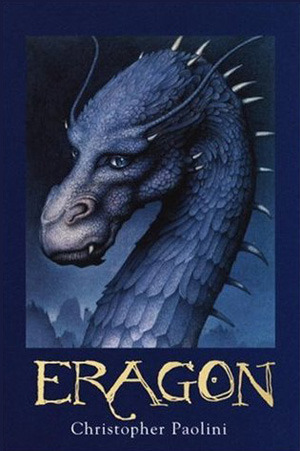
Eragon is a YA epic fantasy novel featuring a boy and his dragon. It’s a familiar story, so no major new ground is broken here. Eragon as a character is not overly compelling. He’s a bit whiny at times, and things come a bit too easy for him, and some of his fighting skills are more advanced than they should be given his age of fifteen. Where I thought the novel was strong was in the world-building. There was a fairly complex and well-developed governmental structure, whose power comes from the emperor who is also a powerful wizard. There was also a strong mythos with the dragon riders of old, who along with their dragons possess great power. They had all been wiped out, that is until Eragon’s discovery of the dragon egg and the hatching of Saphira.
Under the mentorship of an old dragon rider, Eragon goes on the customary journey that is almost a requirement in epic fiction, trying to escape from the clutches of the empire while simultaneously trying to hunt down agents of the Empire who are simultaneously trying to hunt him down, setting up a game of cat and mouse. Being a dragon rider he now finds himself in the middle of a struggle between the Empire and a rival faction of humans, elves, and dwarves. This all sets up for a major battle at the end of the novel.
The story was written at a good pace. There was both action and intrigue. There were certain things I didn’t like about this novel, but on balance, the good outweighed the bad, and I will continue to read more in this series.
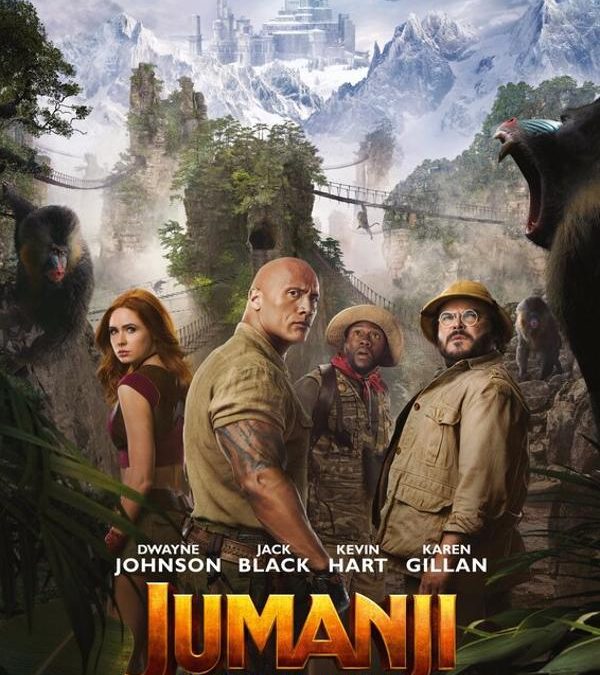
The first Jumanji movie told the story in its entirety, and there was no real reason to make this movie other than the first movie was surprisingly successful and the studio behind it wanted to capitalize on that success. Given that caveat, this was basically a fun, popcorn movie that didn’t require much deep thought. It was much like the first movie, except this go around the returning characters started off knowing about their avatars and the game they were in with the exception of two new characters, played by Danny Devito and Danny Glover. An odd choice bringing in two older, veteran actors, but it worked. They gave the movie a new element by mixing up the avatars from the first movie. I especially enjoyed the Rock trying to portray the Danny Devito character and Kevin Hart trying to portray his older character as well. The actors seemed to have fun with it and overall put in strong performances.
Otherwise, the plot of the sequel was similar to the original. They once again had to travel through dangerous lands with an ultimate objective and trying to avoid getting killed three times in the process, a difficult task given that the two older characters seemed clueless about the game. There were fun and silly moments in this movie, certainly nothing deep or thought-provoking, but if you liked the first movie, you will like this one as well.
What made you want to help start the New York Asian Film Festival?
I used to go to the Music Palace down in Chinatown to see double features when I was in university and fell in love with Hong Kong movies there. Around 1999, the owners put it on the market and some other folks who also loved the place reached out and we all met and tried to see if we could get some cultural agency to buy the building, but no luck. We realized that plenty of people would keep showing the latest Wong Kar-wai and Zhag Yimou movie but who’d show the comedies and romances and action movies we loved. So we all put our money in a pot and started showing them ourselves.
Who is your favorite writer?
It changes constantly, but every book I write has a writer who functions as its spirit animal. For my latest book, The Southern Book Club’s Guide to Slaying Vampires, that was Shirley Jackson. I spent the entire time I wrote it re-reading her books and short stories, including her two memoirs about raising kids, Life Among the Savages and Raising Demons, which are really underrated.
What do you prefer to write: novels, non-fiction, or screenplays?
They’re all hard for me. Novels are deeply immersive and I have to write three books and throw them out for every one book I publish. Non-fiction is back-breakingly labor-intensive because every word has to be true. And screenplays are so stripped down and concise that every sentence requires pages of work to get there. So I hate them all.
What current writing projects are you working on?
I’m revising a screenplay for a crime film set in the South and another one about a mediumship investigation, writing a non-fiction book about martial arts movies coming to America in the Seventies and doing revisions on my next novel, which will be out in 2021.
Who or what are your biggest influences in terms of your writing?
I aspire to get my writing boiled down to the lean, deceptively simple style of someone like Elmore Leonard or George V. Higgins. I fail on a regular basis.
Is there an overall theme to your writing?
I don’t write according to a theme, but it’s more that there are a lot of stories I want to tell. If I started today, it would take me about a decade to get them all down on paper and published.
In your novel, We Sold Our Souls, is Black Iron Mountain a metaphor for anything?
Black Iron Mountain is the prison that we’re all trapped in, the one where only money has value, messiness is discouraged, kindness is mistaken for weakness. Philip K. Dick wrote about a similar construct he called The Black Iron Prison, and Grant Morrison talked about something equivalent to his Anti-Life Equation. I feel like it’s a piece of mental architecture that appears from time to time in fiction almost like a kind of Flying Dutchman. The worst thing about Black Iron Mountain is that while we’re the prisoners we’re also our own jailers.
Is there any subject that is off-limits for you as a writer?
Not that I can think of offhand.
Why did you choose heavy metal to be at the front and center of your novel We Sold Our Souls?
I wanted to write about a musical genre that no one thought was cool, and no one thinks metal is cool. If you say you like metal people make a lot of unflattering assumptions about you and your life. There’s no other style of music that gets that reaction, as far as I can tell. Hip hop comes close, but at least people who listen to it are cool. There’s nothing cool about metal. That’s why I love it. And it helps that metalheads are some of the kindest, sweetest people on the planet.
If Hollywood was making a film adaptation of We Sold Our Souls, and the director asked you to cast the role of Kris Pulaski, who would you choose?
God Save the Queen is a bit of a mishmash of different genres. It’s part alternate history where during the reign of Queen Victoria, she and other aristocrats are plagued with some taking the form of vampires, others werewolves, and others goblins. It’s part fantasy with some shades of romance, although that’s a small part of the novel, with a bit of a steampunk feel to it. Queen Victoria is still alive, and there are divisions between the aristocrats and the humans with half-bloods (half human and half other) somewhere in between.
The protagonist, Xandra Vardan, is part of the Royal Guard, an elite fighting squad of half-bloods whose job it is to defend the aristocrats from humans who might wish them harm. The plot thickens when Xandra’s sister goes missing and is declared to be dead, although she’s not dead, causing Xandra to investigate. In the process, she discovers a conspiracy that she’s at the center of.
By and large, I liked this novel. I like the writing style. Although I generally liked the characterization, if you’ve read any modern urban fantasy, there is a lot of cliché to Xandra and Vex, her alpha werewolf love interest. The biggest shortcoming of this novel is that these two characters, the badass female protagonist, and her bad boy non-human lover, have been done to death and there is no new ground here. The plot was sound, and I enjoyed the steampunk-ish feel to it where there is some technology in this world but not to our levels of technology. Overall, I would give this novel a thumbs up and will be reading the second novel in the series.
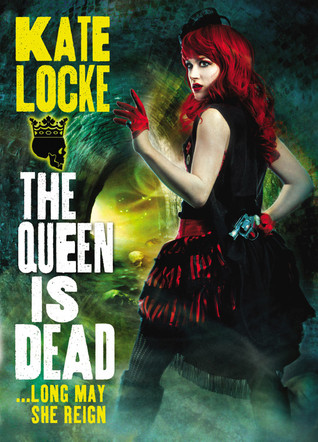
I really enjoyed the first novel in the Immortal Empire Series, but I felt the second novel in the series fell off the mark and didn’t live up to my expectations. For starters, the setup is almost exactly the same as the first novel. One of Xandra’s siblings goes missing and she has to go find them. This time, it’s her brother, Val. She is still involved in a relationship with her werewolf boyfriend, a relationship that is so typical in this genre of the novel. The storyline is very similar to the first novel as well with the exception that Xandra now knows she’s a goblin instead of the mystery in the first novel where she was finding it out. The novel ends very abruptly with no resolution to the storyline except for the missing sibling.
I don’t want to be overly negative since there were elements of the novel that I enjoyed. The writing, for the most part, was strong. The characters were generally well done with a couple of exceptions. The plot moved along and set up for the final novel in the series. Overall, it wasn’t a bad read. It just seemed to be a repeat of the first novel, and no new ground was broken here. It did not deter me from wanting to read the finale and completing the series, which I will be doing soon.