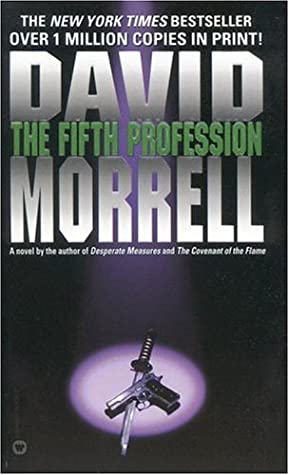
The Fifth Profession is an interesting novel. It’s part espionage thriller and part sci-fi. The crux of the story is that Savage, a former Navy SEAL and executive protector on an assignment to rescue the wife of a wealthy businessman, encounters his Japanese counterpart, Akira, who he saw die when they were serving on an assignment together. Akira has the same memories, except he saw Savage die. They get together and piece together their jumbled memories and find out that many of the things they remembered didn’t actually happen. This leads them back to Akira’s homeland of Japan, where the mystery ensues.
I found this novel to be intriguing. The mystery component was captivating, and I wanted to see how it unfolded. There was action galore with plenty of fight scenes and some chases. It works at that level even without the added element of the jumbled memories. That part of the novel was problematic however, since the false memories storyline really strained believability. To further exacerbate the issue, the author never really explains in any detailed or believable way how the two main characters got their false memories. It was all kind of wave your hand behind the curtains hocus pocus type stuff. Although there was lots of good action, I thought the fight scenes could have been executed a little better. Getting past that, I thought the novel delivered. I was entertained from beginning to end.
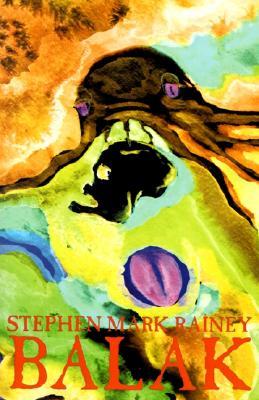
Balak is a Cthulhian mythos style novel set in modern-day Chicago. The novel starts off with the disappearance of a little boy, in part witnessed by Claire Challis, whose own child disappeared not long before that. This leads Claire and her boyfriend, Mike, into a dark church, whose members worship Balak, an ancient figure who serves an even more ancient god, who was around when the world was new in a typically HP Lovecraft motif. The Chicago police become involved. All of this leads to an end of the world scenario, where Balak is trying to use Claire to allow this ancient god to enter our world.
I’ve read a number of Lovecraftian type stories, and this kind of falls in the middle of the pack. There was nothing particularly bad about, but it also doesn’t rise above some of the others I’ve read. For me, the bar is set with Brett J. Talley’s work, whose take on Lovecraft is top-notch. The situation is fairly ordinary. The characters are solid, but none of them fell into the category of someone I was rooting for to succeed. I just couldn’t latch on to them. The novel is very competently written and was a decent read. You could do a lot worse than this novel, but it’s not one that I feel as if I’ll remember a year later.
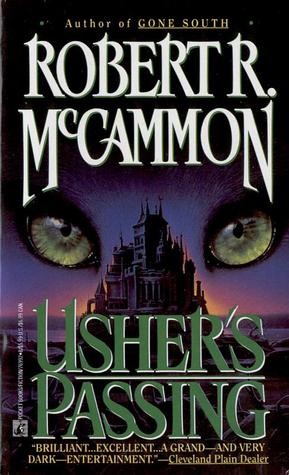
When I first started reading this book, I thought it would be a historical fiction novel featuring Edgar Allen Poe and the Usher family that he wrote about over a century ago. It turned out to be set in modern-day. I was hoping for historical fiction given that McCammon is terrific as an author in that genre. Having said that, Usher’s Passing did not disappoint.
It was an interesting and imaginative tale. In this world, the Usher family is one of the wealthiest in the world, with their fortune tied to the sale of arms. Rix Usher is the outcast of the family. He’s a horror writer (I imagine Robert McCammon put some elements of himself into this character). He’s vehemently against the family business but returns to their compound in North Carolina with his father dying. Although Rix doesn’t want anything to do with the family business, he wants to write an expose/history of the family in sordid detail. But what lurks beneath the surface is the supernatural and how the family has been able to achieve the fortune through ties with otherworldly forces.
There are some nice twists and turns in this novel. The main baddie here is the Pumpkin Man, a supernatural character who has been abducting children for decades. When the reveal was finally made about the Pumpkin Man’s identity, I was surprised. It was a well-delivered set up that made sense in retrospect but caught me off guard. I thought there was good character development in this novel, with a good many memorable characters. The writing was strong and purposeful. The supernatural elements mixed in well with the parts that were grounded in reality. My only negative was that I felt it dragged in certain parts and could have used some trimming to make it a tighter story.
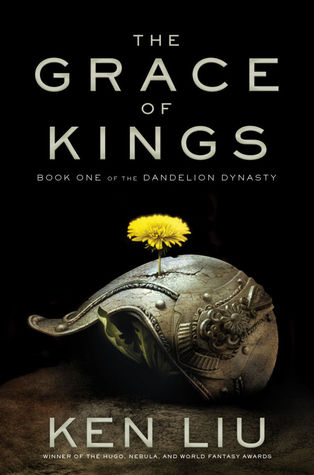
I was hooked in by The Grace of Kings right from the start. There is a lot to like in this novel. I liked this novel because it had the feel of an epic fantasy novel but was written in a very different style. It had a clear Far Eastern influence to it which made it stand apart from many other fantasy novels that I have read. I also liked the mixture of science along with the fantasy as seen by the steampunk style airships featured in the novel as well as other scientific developments, including a crude type of submarine that was introduced.
The characters were also good. There were so many characters that some of them either blended together with other characters or were not particularly notable enough that by the end of the novel, I had no real remembrance of them and what they did. But there were a great many interesting and memorable characters. What I especially liked was that even the villain characters were well crafted and interesting. The ultimate villain in the novel is Mata Zyndu, who starts off as heroic characters and friends to Kuni Garo, the main protagonist. Although Mata goes off the rails and eventually turns into a tyrant and bloodthirsty killer, there is a clear nobility to the character, and Mata is the hero of his own story. He is convinced that his way is right and just. Even the Emperor at the beginning is convinced that his vision is a good one. In some ways, he was correct, although he was clearly misguided.
There were comparisons of this novel to Game of Thrones, but I wasn’t seeing it early since it has a more lighthearted tone and didn’t have all of the palace intrigues as Game of Thrones, but as it went along, I saw that there was quite a bit of deceit and backstabbing, even if it was lighthearted. The only real drawback is that I thought the novel could have used some definite editing. It was overly long in spots, and it dragged in a couple of others, but on balance, this was a compelling, well written, well crafted, and enjoyable novel.
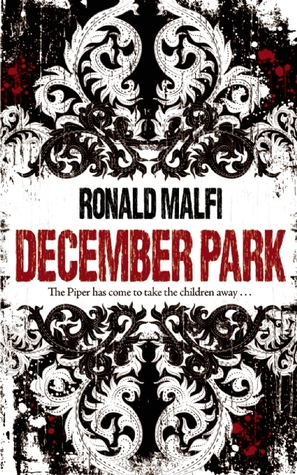
December Park is a dark, moody, atmospheric novel that is more psychological thriller and mystery than it is a horror novel. It takes place in the nineties in suburban Maryland. Angelo Mazzone and his group of outcasts obsess over a series of missing children in their area involving a potential serial killer called The Piper. Even though Angelo’s father is a detective investigating the case, he and his friends believe they can accomplish what the cops cannot, which is to find the killer and bring him to justice.
What I liked most about this novel was the quality of the writing. As I mentioned, it created a dark, brooding atmosphere that really added to the novel. I thought the characterization was also quite strong. Angelo and his friends were well done, not to mention Angelo’s father, who was a sympathetic and relatable character. The novel had a strong mystery component to it and a nice build-up. What I didn’t like was the ending, in particular the reveal of the Piper. That didn’t make much sense to me and I didn’t feel it was adequately explained. It did bring the novel down a bit but overall, it was still a strong read.
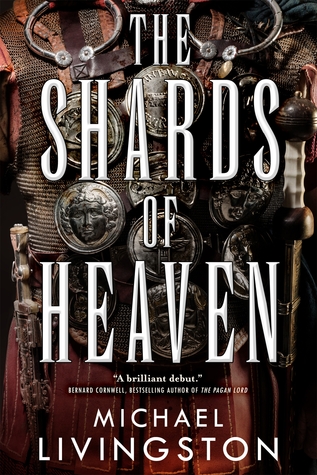
When I read the back cover of The Shards of Heaven, I found the concept tantalizing. I’m a big reader of both fantasy and historical fiction. The combination sounded fascinating, especially when setting it at the time of the Roman Empire with Mark Antony and Cleopatra.
I tend to be pretty critical in my reviews, but I can’t find much to criticize. The writing is exceptional. The pace was just right, with almost no slow spots to be found. I also enjoyed the characterization. The novel is chock full of memorable characters, especially Titus Pullo and Lucius Vorenus, who found themselves in the show Rome as well despite not being particularly well known historical figures. On both the Roman and Egyptian side, the characters are well-drawn from the main protagonists and antagonists to the side characters.
I also really enjoyed the fusion of history and fantasy. It was so well done that it was often hard to keep track of what may have historically happened and where the fantastical elements were inserted. I like the concept of the Shards of Heaven and how they were part of the staff of Moses/trident of Poseidon and the Ark of the Covenant. The novel started strong, finished strong, and didn’t sag anywhere in between. This novel was a winner and I look forward to reading the next book in the series.