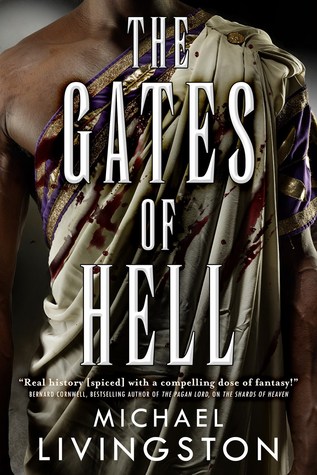
The bar was raised quite high for me after reading The Shards of Heaven, the first installment in this trilogy. I thought the novel was absolutely brilliant. When my expectations are that high, the sequel generally doesn’t live up to my expectations. Not so with The Gates of Hell. I can’t decide if I liked it better than the first novel, but it’s a terrific and enjoyable book.
Part of it is the writing style. Michael Livingston is a terrific writer, a master of prose. His character development is truly something. An example of this is the character Octavian or Caesar Augustus, who was quite villainous in the first novel but becomes more sympathetic and likable in this book. Even the more loathsome characters like Tiberius and Thrasyllus are well done. But it’s also the way he blends fantasy with history in such a seamless fashion that sets this novel apart.
There are two separate storylines in this novel and they alternate from chapter to chapter. One storyline follows Juba and Selene as they journey with Augustus in Northern Spain, where they encounter a guerilla leader who controls another of the shards. The second storyline takes place in Egypt with the Ark of the Covenant. They are both compelling storylines with lots of drama and tension. I expected the two stories to eventually converge, but it never happened. My guess is that it will in the final installment of the trilogy.
This novel is well worth the read. It’s a winner and I can only hope that the final book in the trilogy can live up to the first two.
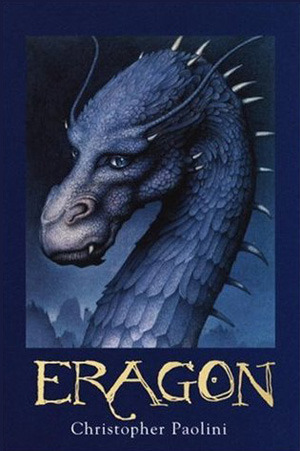
Eragon is a YA epic fantasy novel featuring a boy and his dragon. It’s a familiar story, so no major new ground is broken here. Eragon as a character is not overly compelling. He’s a bit whiny at times, and things come a bit too easy for him, and some of his fighting skills are more advanced than they should be given his age of fifteen. Where I thought the novel was strong was in the world-building. There was a fairly complex and well-developed governmental structure, whose power comes from the emperor who is also a powerful wizard. There was also a strong mythos with the dragon riders of old, who along with their dragons possess great power. They had all been wiped out, that is until Eragon’s discovery of the dragon egg and the hatching of Saphira.
Under the mentorship of an old dragon rider, Eragon goes on the customary journey that is almost a requirement in epic fiction, trying to escape from the clutches of the empire while simultaneously trying to hunt down agents of the Empire who are simultaneously trying to hunt him down, setting up a game of cat and mouse. Being a dragon rider he now finds himself in the middle of a struggle between the Empire and a rival faction of humans, elves, and dwarves. This all sets up for a major battle at the end of the novel.
The story was written at a good pace. There was both action and intrigue. There were certain things I didn’t like about this novel, but on balance, the good outweighed the bad, and I will continue to read more in this series.
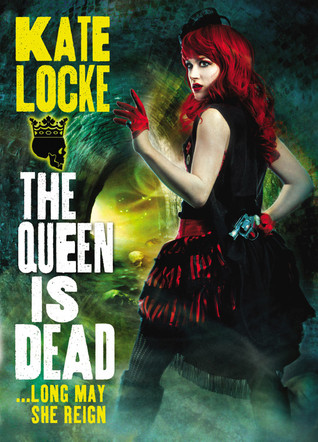
God Save the Queen is a bit of a mishmash of different genres. It’s part alternate history where during the reign of Queen Victoria, she and other aristocrats are plagued with some taking the form of vampires, others werewolves, and others goblins. It’s part fantasy with some shades of romance, although that’s a small part of the novel, with a bit of a steampunk feel to it. Queen Victoria is still alive, and there are divisions between the aristocrats and the humans with half-bloods (half human and half other) somewhere in between.
The protagonist, Xandra Vardan, is part of the Royal Guard, an elite fighting squad of half-bloods whose job it is to defend the aristocrats from humans who might wish them harm. The plot thickens when Xandra’s sister goes missing and is declared to be dead, although she’s not dead, causing Xandra to investigate. In the process, she discovers a conspiracy that she’s at the center of.
By and large, I liked this novel. I like the writing style. Although I generally liked the characterization, if you’ve read any modern urban fantasy, there is a lot of cliché to Xandra and Vex, her alpha werewolf love interest. The biggest shortcoming of this novel is that these two characters, the badass female protagonist, and her bad boy non-human lover, have been done to death and there is no new ground here. The plot was sound, and I enjoyed the steampunk-ish feel to it where there is some technology in this world but not to our levels of technology. Overall, I would give this novel a thumbs up and will be reading the second novel in the series.
I really enjoyed the first novel in the Immortal Empire Series, but I felt the second novel in the series fell off the mark and didn’t live up to my expectations. For starters, the setup is almost exactly the same as the first novel. One of Xandra’s siblings goes missing and she has to go find them. This time, it’s her brother, Val. She is still involved in a relationship with her werewolf boyfriend, a relationship that is so typical in this genre of the novel. The storyline is very similar to the first novel as well with the exception that Xandra now knows she’s a goblin instead of the mystery in the first novel where she was finding it out. The novel ends very abruptly with no resolution to the storyline except for the missing sibling.
I don’t want to be overly negative since there were elements of the novel that I enjoyed. The writing, for the most part, was strong. The characters were generally well done with a couple of exceptions. The plot moved along and set up for the final novel in the series. Overall, it wasn’t a bad read. It just seemed to be a repeat of the first novel, and no new ground was broken here. It did not deter me from wanting to read the finale and completing the series, which I will be doing soon.
We Sold Our Souls is a fascinating and unique novel. I truly never have read anything quite like it. My interest in the novel is heightened by me being a life long heavy metal fan. I don’t know if I would have liked this nearly as much if the focus of the novel was, say country instead of metal. That said, I think this novel worked in many different ways, and would still be a great read even if you had no interest in heavy metal.
For starters, the writing is really strong. The voice is loud and clear. The grammar, flow, and pace are all tight. I liked the way the author broke into the action with radio and television interviews or news reports to fill in the details. The characterization was also strong. Chris comes out loud and clear, as do some of the side characters. Even the villains in the story to a certain level are sympathetic and are not just evil for the sake of being evil. It’s easy to sympathize with a musician who will sell their soul not just for fame and fortune but to be legendary, for their music to live on long after they are gone. There is a lot that I liked about this novel, and my complaints are only minor. This is a horror novel well worth reading.
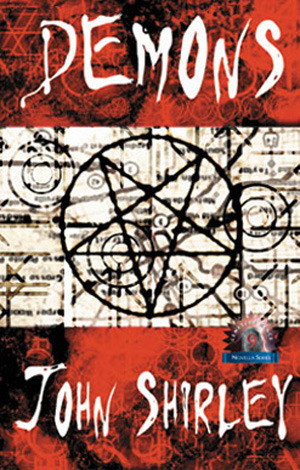
Demons for me is a tale of two books. Apparently, it started off as a novella, and later became a novel, when a second, longer part was added to it. The first part of demons was great. I thoroughly enjoyed reading it. It had an interesting concept, a kind of light, understated tone to it, a well-developed plot, and a decent conclusion. The characters were just so-so, but there was a lot to like about it. I wished that was all I had read because the following, longer part did not come close to delivering.
All of the charm and wit the novella had, the extended novel was lacking. The story was incoherent and nonsensical. The author wanted the reader to believe that through some sort of control of the media, that people did not believe that the demon invasion happened, despite the fact that thousands upon thousands of people died, it had dominated every facet of the world when it happened, every single human being alive witnessed it, the president of the United States was killed by a demon, and the vice president was running the country through a bunker. Am I missing something? In the novella, demons were bad and they overran the planet. Now, the author decided to use the ridiculously overused trope that it was the evil industrial corporations that were responsible for summoning these demons. Writers have a habit of using the evil, industrial corporation as the villain like a crutch. It’s old and tired. And for some reason it would be desirable for these folks to have demons destroy the planet and have it become some sort of dystopian world. Yeah, that’s exactly what a corporate industrialist would want. None of it made sense, including the part where they take away a child so they could replace him with a member of the circle. It was a big mess. I would recommend reading the first part and stopping there.