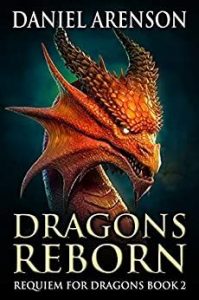
In book 2 of Daniel Arenson’s Requiem for Dragons trilogy, the book continues immediately after book 1 with little regard to bringing readers up to speed with what happened in the previous novel, which is fine if you are reading them one after the other like I did, but if there was a gap in between books or you didn’t read book 1 you would be lost.
In book 2, Cade and the other weredragons are attempting to create copies of the book of Requiem to spread among the people to show that weredragons aren’t so bad, while the paladins of the Cured Temple hunt them down. Elsewhere, other weredragons are trying to lead an attack against the Cured Temple.
I thought the first book in the trilogy was okay. I liked the concept and thought there was entertainment value and potential but this second novel has left me disinterested. The biggest problem is that the writing is flawed. The author doesn’t bring the action to the reader. The descriptions in the action sequences lack the kind of sensory detail to make me as a reader feel what the characters are feeling. Characterization is also lacking. Every major character in this story falls in love with another character at the drop of a hat. They barely know another character and are already madly and deeply in love with them. If this was isolated to one instance it would be okay, but basically every character has this happen to them. They also each harbor terrible, dark things that have happened in their past. Basically, all the characters are constructed the same way. The three main antagonists in this story are just poorly constructed.
I gave book 2 a try, but I just can’t muster enough interest to complete the trilogy, even though I already have the ebook for book 3.
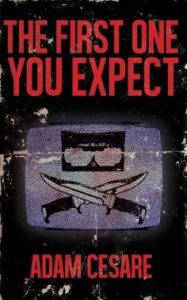
In The One You First Expect, Tony Anastos makes micro budget splatter horror movies with very little recognition or ability to make money. Things change when he meets Anna, his coworker at the grocery store he works at when not making these movies. Anna has far greater aspirations as an actress and works with Tony on a kickstarter for his new movie—something that becomes a smashing success when Anna actually kills someone in the kickstarter video. That’s only the start of what Anna is willing to do. Her bloodthirstiness seems to know no bounds.
The writing in this novel is probably the strongest aspect of it. The books moves at a fast clip and is an easy read. There is nothing heavy duty in this novel. The concept is interesting and the execution is done well. The character that really stands out for me is Anna. She’s basically a sociopath hiding under a pretty veneer. But she’s a well developed character who knows what she wants and will do what it takes to achieve her goals. Tony is not nearly as strong as a character. He just goes along for the ride and doesn’t drive any of the action. He’s a character who has things happen to him rather than making things happen. Perhaps this is done by design to make his character contrast with Anna.
This was a fun read, and if you’re looking for an enjoyable horror novel, The One You First Expect delivers. Here is a link on Amazon.
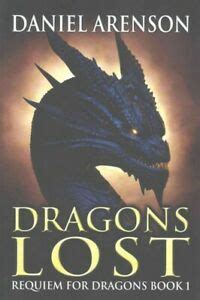
Dragons: Lost is the first installment in the Requiem for Dragons trilogy by Daniel Arenson. In this story world, weredragons—people who can change into dragons—once ruled the roost and now are hunted down and killed and are virtually extinct. Newborns are tested to see if they are weredragons, and if they are, they have the ability to change into a dragon removed from them by paladins of the Cured Temple, a very repressive group of people who force the people to live in austerity while they live the good life. The story starts when Cade transforms into a dragon after seeing his baby sister get her dragon abilities removed from her and then becomes hunted by the paladins of the Cured Temple. He then tries to find others like him.
For me, this is just an okay novel. The concept is a good one. I like the idea of weredragons. The world building is pretty good. But the book falters beyond the high level concepts it has in it. The writing is a bit underwhelming. The biggest problem with it, especially when it comes to the action scenes, is that the description is to general. I don’t feel as if I’m in the scene and part of the action when reading these scenes. There’s a lack of visceral, sensory detail, and it seems as if the author is just skimming through these sections. Characterization is also lacking. Every character seems to have some horrible dark thing that has happened to them in their past that they are trying to forget yet haunts them. The villains in the story, are particularly poorly written. They lack dimension and are one-note characters.
The novel does provide a good bit of entertainment value, and despite some of these flaws is worth reading, and I will continue on with this trilogy.
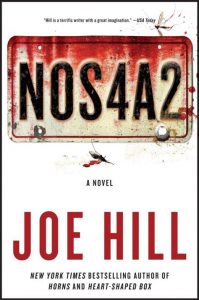
Nos4a2 might have the single coolest cover an any novel I have ever seen. And although you may not be able to judge a book by its cover, it certainly got me wanting to read it. When I first saw the title, I figured the novel would be about vampires, but there are no vampires residing inside—at least not in the traditional sense of the word. I suppose that the story’s villain, Charles Manx, is a type of vampire. He doesn’t drink blood, but he does feed off the emotions of children, who keep him alive far longer than any person would expect to live, living in Christmasland—a fantasy world of his own making.
The foil in this story for Charles Manx is Victoria McQueen. Since she was a small child, Victoria had the ability to get on her bike and find things. She, along with others like her, have talents similar to Manx, but they don’t use their ability to abduct children. As a teen, she runs into Manx, and he is arrested for abducting her. Later in her messed up life, after she has a child of her own, Manx and his Rolls Royce get out of his confinement and return to Christmasland after taking Victoria’s son captive.
This was an imaginative and enjoyable novel. The world of the story is richly built. The writing is captivating. For the most part, the characterization is strong, although I wasn’t so enamored with Victoria McQueen. She was a bit hard to root for as a protagonist. The story was overly long and could have been trimmed, especially the second third of the novel. But I think what really stood out for me was the story’s villain, who, although he is a despicable character, is the hero of his own story and truly believes that what he is doing is good. I think villains are hard to get right and Joe Hill nails it.
Season 4 of Stranger Things had a darker and more horror feel to it than any of the previous seasons of the show, which I appreciated. There were allusions to Stephen King and Nightmare on Elm Street—even going so far as bringing in Robert Englund to play one of the roles in the Max possession episode, which I thought was the best episode of the season. That horror feel was something that was pervasive throughout the season and enjoyable.
One thing that didn’t work so well was the flood of new characters that they brought into the season. Of course, many of them served as cannon fodder so that they could be killed off. Through four seasons, the show has exhibited a pattern of only willing to be kill off newly introduced characters, and not any of the bigger characters, which I think is a shortcoming of the show. They teased the death of Hopper last season and Max this season, but they won’t take that kind of risk.
Another thing that didn’t work for me was the lack of believability of some of the more ordinary parts of the show. I’m perfectly fine stretching disbelief about the upside down, people with superpowers, and any of the supernatural elements of the show, but this season, a government agency going into a California neighborhood and shooting it up with machine guns, rival government agents killing each other and torturing other members, and that entire scene when Mike and company went to Utah to see Dustin’s girlfriend was a bridge too far and really hurt the season.
But mostly this was a really good season. I would probably rank it behind season 1. There were three separate story lines that coalesced in the end. The season had great tension and cool moments. As the child actors have grown, they have become less interesting, but the strength in the characters are with the older characters, in particular Steve, Robin, and Murray really shined this season. I would have liked this season to be the last for Stranger Things before they wear out their welcome, but clearly the ending set up for a season 5.